How Long Does a Game Prototype Actually Take to Build?
Ask ten developers how long a game prototype takes and you’ll get ten different answers. That’s not because developers are guessing, it’s because “prototype” means genuinely different things depending on who’s using the word and what they’re trying to learn from it.
A prototype that proves a core mechanic works takes a different amount of time than a prototype designed to pitch a publisher. A vertical slice that demonstrates art direction and production quality is a fundamentally different deliverable from a grey-box playable used to validate whether a game loop is fun. All of these get called prototypes. None of them take the same amount of time.
This guide cuts through the ambiguity, defining what prototypes actually are, what drives their timelines, and what realistic expectations look like for different project types and team sizes.
- What Is a Game Prototype?
- What Drives Game Prototype Timeline?
- How Long Does a Game Prototype Take? By Type
- Prototype Timelines by Genre
- How to Prototype Faster Without Cutting the Wrong Corners
- Common Mistakes That Extend Prototype Timelines
- Working With a Development Partner for Prototyping
- Frequently Asked Questions
What Is a Game Prototype?
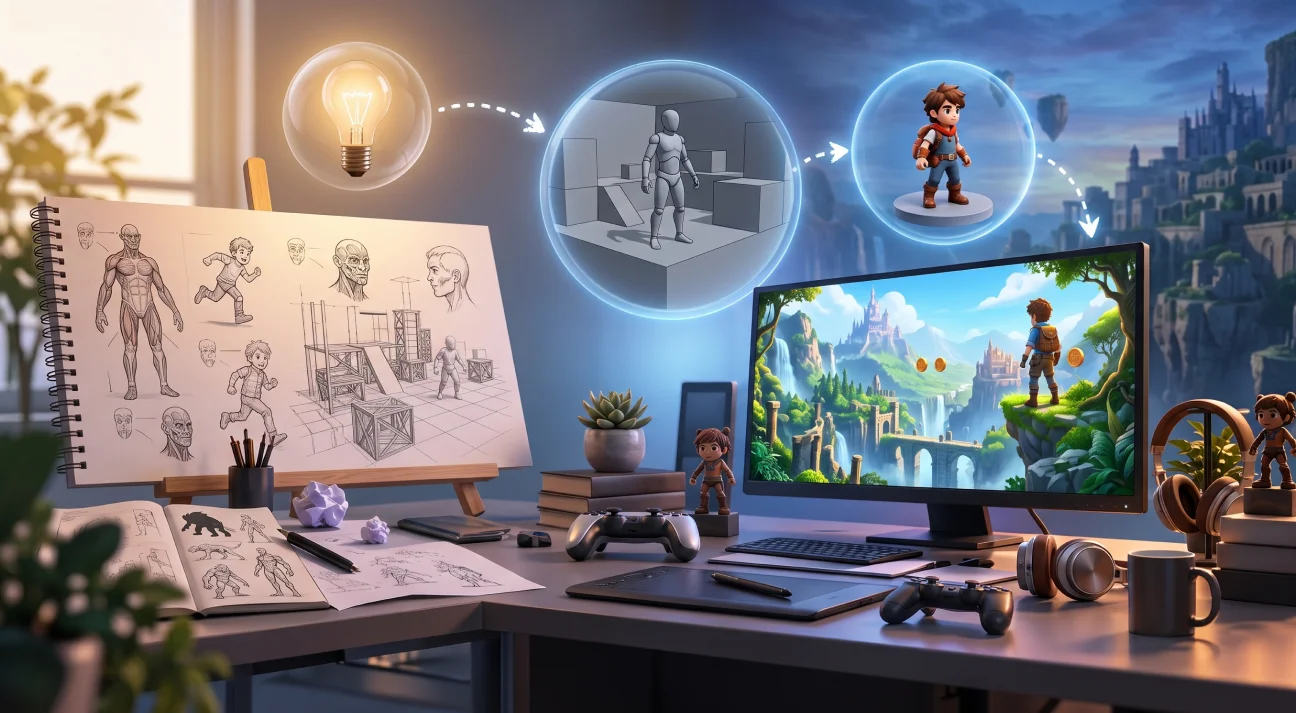
A game prototype is the earliest playable version of a game concept, built to test a specific hypothesis, not to ship. The hypothesis might be: “Is this core mechanic fun?” or “Does this game loop retain players past the first session?” or “Can we produce this visual style at our target budget?” The prototype exists to answer that question as quickly and cheaply as possible.
The word “prototype” gets conflated with several distinct deliverables that have meaningfully different scopes and timelines:
Proof of Concept (PoC) – The fastest and cheapest type. Usually a single mechanic, minimal art, no UI. Built to answer one question: does the core gameplay idea work in practice? Often built by one or two people in days or weeks.
Playable Prototype – A more complete experience that includes the core loop, basic progression, and enough context for a player to understand what the game is trying to be. No final art, placeholder audio, rough UI. Typically takes weeks to a couple of months.
Vertical Slice – A polished, representative section of the game that shows what the full product will look, sound, and play like. Often used for publisher pitches or investor presentations. Significantly more expensive and time-consuming – not technically a prototype in the purest sense, though it’s commonly called one.
Game Jam Prototype – Built under extreme time constraints (24–72 hours) to explore an idea. Intentionally rough and incomplete. The goal is creative exploration, not viability testing.
Understanding which of these you actually need is the first decision – and the one that determines timeline more than anything else.
What Drives Game Prototype Timeline?
Before the numbers, the variables. Prototype timelines are determined by five factors more than anything else.
1. Scope clarity
The single biggest driver of how long a prototype takes is how clearly the question it’s trying to answer is defined. A prototype built to answer “is tapping to jump fun?” can be built in an afternoon. A prototype built to answer “is this game concept viable?” is answering a much larger question and will take proportionally longer.
Studios that define their prototype goal in a single sentence before they start building almost always finish faster than studios that prototype without a clear success criterion. The discipline of asking “what does this prototype need to prove?” before writing code is what separates a two-week prototype from a two-month one.
2. Team size and composition
A solo developer prototyping in Unity or Unreal without art assets or audio works differently from a small team with a programmer, a designer, and an artist working in parallel. More people means more parallel progress but also more coordination, more integration, and more decisions that require alignment. For short prototypes, a solo developer or two-person team often moves faster than a larger team.
3. Art requirements
Grey-box prototypes, built with primitive shapes, placeholder assets, and no visual polish, take a fraction of the time of visually representative prototypes. The decision to use placeholder art versus concept-accurate art is often the biggest time variable in prototype production. A game jam prototype uses grey boxes. A publisher pitch prototype needs to show visual direction. These are not the same build.
4. Existing technology and tools
A team prototyping in an engine they’ve used for ten years moves faster than a team learning a new engine while also prototyping. Similarly, studios that invest in pre-built tools, systems, and asset packs reduce prototype time substantially, time not spent building an inventory system, a UI framework, or a character controller from scratch is time spent on the core mechanic being tested.
For teams working in Unity or Unreal Engine, pre-built production-ready systems from 300Mind’s asset catalogue on Unity Asset Store, or tools on Fab for Unreal, can compress prototype timelines by removing weeks of foundational system work.
5. Feedback loops and iteration
A prototype’s timeline isn’t just build time, it’s build time plus playtest time plus iteration time. The first build is rarely the prototype that answers the question. Most prototype timelines include two to four rounds of iteration before the hypothesis is properly tested. Teams that ignore iteration time in their estimates consistently deliver prototypes that answer the question poorly.
How Long Does a Game Prototype Take? By Type
Game prototype development can take anywhere from a few days to several months, depending on the prototype type, scope, and what you need to validate. Here’s a breakdown of realistic timelines for proof-of-concept prototypes, playable prototypes, vertical slices, and game jam prototypes.
Proof of Concept Prototype
Timeline: 1 day – 2 weeks
What’s included: Single mechanic, placeholder visuals, no audio, no UI. Functional enough to run and play, not functional enough to show anyone outside the core team.
Who builds it: One developer, occasionally two. Often a programmer or a designer who codes.
Real-world examples: The jump mechanic test in a platformer. The card draw and resolution logic in a deck-builder. The first test of a physics-based puzzle. The turn structure in a strategy game.
When it’s done: When the question it was built to answer has been answered, yes or no. A proof of concept that lingers because nobody is willing to call it isn’t a prototype, it’s premature production.
Playable Prototype
Timeline: 2 weeks – 3 months
What’s included: Core gameplay loop functional, basic progression or session structure, rough UI sufficient for playability, placeholder or low-fidelity art, minimal audio.
Who builds it: 2–5 people depending on the scope of the loop being tested.
Real-world examples: A complete run of a roguelike from start to death. A five-minute session of a mobile casual game. A single match of a multiplayer game. Three levels of a puzzle game.
Why the range is wide: The difference between two weeks and three months is almost entirely scope. A clean, well-defined core loop can be prototyped quickly. A loop that involves multiple interconnected systems, inventory, crafting, progression, combat, and economy, for example, takes longer even at placeholder quality.
Common mistake: Scope creeping a playable prototype into a vertical slice by adding features beyond what the hypothesis requires. Every feature added beyond what’s needed to test the core question extends the timeline without increasing learning.
Vertical Slice
Timeline: 2 months – 12 months
What’s included: A representative, polished section of the game that demonstrates final art direction, audio, gameplay, and production quality. Typically 15–30 minutes of gameplay. Built to answer “what will this game look and feel like at completion?”
Who builds it: A full or near-full production team, often the same team that will build the full game.
This is not a prototype in the traditional sense. A vertical slice is early production, not pre-production validation. It’s built after the prototype has validated the concept, not instead of it. Studios that conflate vertical slice with prototype often spend 6–12 months “prototyping” before realising they’ve been in production the entire time.
Publisher context: Most publishers asking for a vertical slice are asking for 2–4 months of polished production, not a rough playable. Be clear about which deliverable is actually being requested before scoping.
Game Jam Prototype
Timeline: 24 hours – 72 hours
A special case. Game jam prototypes are creative exploration under extreme time constraints, not viability validation. They teach developers to ship, to make decisions under pressure, and to strip ideas to their most essential mechanic. They are valuable for different reasons than a standard prototype, not because they validate commercial viability, but because they build the muscle memory of execution.
Most game jam prototypes shouldn’t become products. The ones that do almost always require a full rebuild from the jam prototype, not an iteration on it.
Prototype Timelines by Genre
Genre complexity shapes prototype scope even when the core mechanic is the same. Here are realistic timelines for a playable prototype across major genres:
| Genre | Prototype Timeline | What’s hardest to prototype |
| Puzzle | 1–3 weeks | Rule clarity and player comprehension |
| Platformer | 1–4 weeks | Controls feel and level design interaction |
| Match-3 / Casual | 1–3 weeks | Loop satisfaction and pacing |
| RPG | 4–12 weeks | Combat, progression, and narrative coherence |
| Strategy (TBS/RTS) | 4–10 weeks | AI and decision-making depth |
| Survival / Crafting | 6–16 weeks | Interconnected systems |
| Multiplayer / PvP | 6–16 weeks | Networking and balance |
| Metroidvania | 3–8 weeks | Exploration loop and ability gating |
| Horror | 2–6 weeks | Atmosphere and tension pacing |
| Narrative / Visual Novel | 2–6 weeks | Branching and player investment |
These assume a small team (2–4 people), placeholder art, and a well-defined hypothesis. Add 30–50% for single-developer timelines. Add significant time for any genre involving multiplayer networking.
How to Prototype Faster Without Cutting the Wrong Corners
Faster prototyping isn’t about removing the work that matters; it’s about removing work that doesn’t help answer the core gameplay question. Define the hypothesis, limit the scope, use proven tools, and get the prototype in front of players early.
Define the question before you write code
Every day of prototyping that happens before the question is defined is potentially wasted. Write the hypothesis down: “This prototype will prove that [mechanic] is fun because [players will do X].” If you can’t write it in one sentence, you’re not ready to prototype.
Use grey-box art as long as possible
Art slows prototypes down more than almost anything else. Placeholder cubes, capsules, and coloured planes move faster and let the team focus on what matters, whether the mechanic works. Add concept-accurate art only when the mechanic has been validated and the prototype is moving toward a vertical slice.
Timebox ruthlessly
Set a prototype deadline before production begins. Two weeks. Four weeks. Eight weeks. Whatever fits the scope. Work backwards from that deadline to cut features down to the minimum needed to answer the question. The discipline of a timebox forces scope decisions that an open-ended prototype never forces.
Use pre-built systems for everything except what you’re testing
The core mechanic is what you’re learning about. Everything else, UI, inventory, saves, character movement, audio management, can be handled by pre-built tools and assets. Studios that build supporting systems from scratch during prototyping spend their learning budget on the wrong problems.
Pre-built tools for Unity projects are available through 300Mind on Unity Asset Store and Superhive. Unreal Engine tools are available through Fab. Using production-ready systems for everything outside the core mechanic is one of the highest-leverage decisions a prototype team can make.
Playtest earlier than feels comfortable
The prototype isn’t done when it compiles, it’s done when someone outside the team has played it and given feedback. Prototype teams that wait until the build “feels ready” to playtest consistently spend more time than teams that put rough builds in front of players at every stage.
Common Mistakes That Extend Prototype Timelines
Prototype timelines often stretch when teams add unnecessary systems, polish too early, or skip playtesting. Avoiding these mistakes keeps development focused and efficient.
Prototyping without a hypothesis. Builds that aren’t testing a specific question tend to accumulate features rather than answer questions. Define the hypothesis before the first line of code.
Adding systems before the core mechanic is validated. Inventory, crafting, progression, and economy don’t need to exist before the core mechanic is proven. Add them after, not during.
Using the prototype build as the production foundation. Prototype code is written to answer a question quickly, not to scale. Attempting to build the full game on top of prototype code creates technical debt that compounds for the entire project. Rebuild from the prototype’s learnings, don’t iterate on the prototype’s codebase.
Treating the vertical slice as a prototype. If the team is already thinking about final art, final audio, and final UI, they are in production, not prototyping. That’s not wrong, but it needs to be budgeted and resourced accordingly.
Skipping the playtest iteration cycle. A prototype that isn’t playtested hasn’t answered its question. The answer to “is this mechanic fun?” cannot be given by the people who built the mechanic. It requires players who didn’t.
Working With a Development Partner for Prototyping
For publishers, IP holders, and organizations entering the games market, prototyping with an experienced external development partner compresses timeline significantly. A studio that has built hundreds of prototypes across dozens of genres brings pattern recognition that an in-house team building their first game simply doesn’t have.
300Mind works with clients across prototype, vertical slice, and full-cycle development, providing scoping, hypothesis validation, and rapid iteration across Unity and Unreal Engine. For projects that need to move from concept to playable quickly, an experienced partner reduces the time spent on foundational decisions and focuses production on what the prototype actually needs to prove.
Frequently Asked Questions
A game prototype typically takes between one day and three months depending on the type. A proof of concept for a single mechanic can be built in one to five days. A playable prototype with a complete core loop takes two to eight weeks for most game types. A vertical slice, a polished representative section of the game, takes two to twelve months and is closer to early production than prototyping.
A game prototype should be exactly as long as it needs to be to answer the question it was built to answer, no longer. For a mechanic test, five to fifteen minutes of gameplay is typically sufficient. For a loop test, a complete session (however long that is in the target game) is the minimum. For a vertical slice, 15–30 minutes of representative gameplay is standard for publisher presentations.
Yes, if the scope is limited to a single mechanic or core interaction. Many studios build weekly mechanic tests as part of pre-production. These aren’t complete prototypes, but they answer specific questions quickly and cheaply. A week is not enough time to prototype a complete game loop for most genres.
Unity is generally the fastest engine for rapid prototyping due to its large asset store, accessible scripting, and shorter iteration cycles. Unreal Engine 5 offers significantly higher visual fidelity but has a steeper learning curve that can slow down teams unfamiliar with it. Godot is increasingly popular for prototype work due to its lightweight footprint. The fastest engine is always the one the team knows best.
Use existing assets for everything that isn’t the core mechanic being tested. Pre-built systems, UI frameworks, character controllers, and environment assets are available on Unity Asset Store and Fab Marketplace and can save weeks of work on non-critical prototype components. Build from scratch only the specific mechanic or system the prototype is designed to validate.
A prototype is done when it has answered its hypothesis, yes or no. If the prototype has been playtested by people outside the core team and the question “does this mechanic work?” has a clear answer, the prototype has served its purpose. Prototypes that continue past the point of answered hypotheses are usually transitioning into production, whether the team acknowledges it or not.