How NVIDIA Omniverse Is Transforming Multi-Site Enterprise Workflows
Managing complex, multi-site enterprise projects across distributed global teams remains a complex logistical challenge. Historically, a team in one region exports a design version, packages the massive file payload, and transmits it across regional data lines to global stakeholders.
This traditional workflow inherently introduces friction. Teams frequently face localized feedback delays, mismatched software tools, version control conflicts, and accidental data overwrites. The outcome is a slow, error-prone pipeline that degrades engineering velocity and inflates development costs.
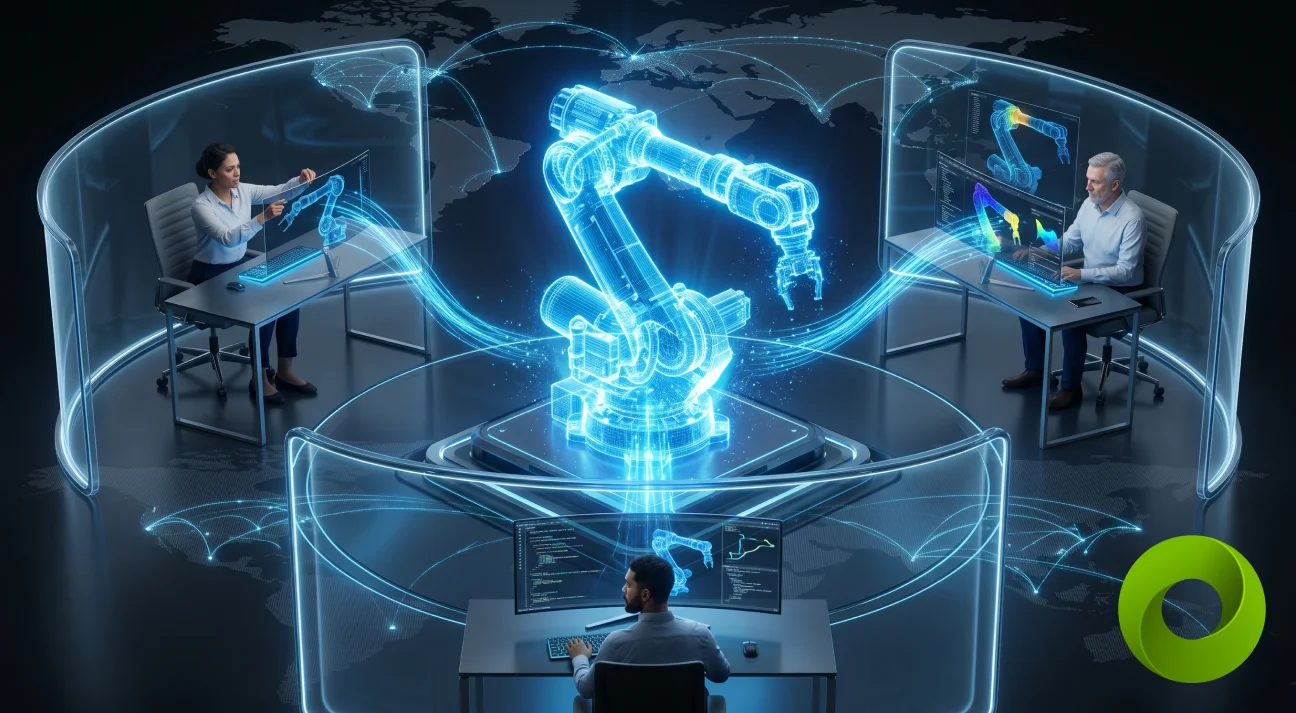
NVIDIA Omniverse solutions resolves this systemic bottleneck by serving as a unified, real-time industrial computing layer. It establishes a shared, synchronized virtual environment where distributed global operations can design, simulate, and optimize assets at the same time.
This post analyzes how this integrated virtual environment dismantles entrenched organizational data silos, optimizes multi-site enterprise workflows, and accelerates operational efficiency on a global scale.
- The Problem with Multi-Site 3D Workflows Today
- What Is NVIDIA Omniverse?
- How Omniverse Solves Multi-Site Collaboration Challenges
- Real Enterprise Use Cases of Nvidia Omniverse
- What Enterprises Should Evaluate Before Adopting Omniverse?
- Conclusion
- How Can 300Mind Help Nvidia Omniverse Multi-Site Enterprise Workflows?
- FAQs
The Problem with Multi-Site 3D Workflows Today
Picture a manufacturing company with three offices. A design team in Germany, a structural engineering team in India, and a project review team in the United States. The product being designed is a complex industrial machine. The German team works in CATIA. The India team uses Revit. The U.S. team reviews everything inside Unreal Engine.
When the German team finishes a round of changes, they export the file, compress it, and send it across. The India team cannot open it natively. Someone spends half a day converting it. The converted file loses some metadata. The India team makes their changes and sends it back. The U.S. team gets a version that is already two steps behind.
By the time a shared design review happens, 48 hours have passed. If anyone spots a problem during that review, the cycle starts again.
This is how most multi-site 3D workflows operate today, across industries ranging from architecture and construction to automotive and aerospace.
There are four specific friction points driving this breakdown:
1. File Format Incompatibility
Every major 3D application uses a different native format. CATIA, Revit, Maya, and Unreal Engine cannot directly open each other’s files. Each handoff between teams requires manual conversion, which takes time and often introduces errors or data loss.
2. Data Transfer Delays
A single 3D model for a large commercial building or industrial machine can run into tens of gigabytes. Transferring files of this size across international office networks is slow, and version confusion is common. Teams regularly review outdated files without realizing it.
3. Sequential Approval Bottlenecks
Because teams cannot work inside the same environment simultaneously, design reviews happen one after another rather than in parallel. One team waits for another to finish before they can begin. This extends design cycles significantly, especially when time zones are involved.
4. Gap in Computation
Rendering complex 3D models in real time requires serious GPU power. Most remote and branch-office workstations do not have it. This forces either a reduction in visual quality during reviews or a dependency on teams traveling to a central office, which adds cost and delay.
What Is NVIDIA Omniverse?
Nvidia Omniverse is a collection of API’s, SDK’s and services utilized to build, simulate and operate AI application and digital twins’ models.
In simpler terms, it is the infrastructure layer that connects different 3D design and simulation tools so that teams working in different software, from different locations, can collaborate on the same virtual environment at the same time.
Three components of Omniverse make this work:
- Omniverse Nucleus is the central collaboration engine that manages the shared 3D environment and transmits every change between connected users in real time.
- Omniverse Connectors are plug-ins for tools enterprises already use, including Autodesk Revit, Dassault CATIA, Bentley MicroStation, and Unreal Engine, so no team needs to drop familiar software.
- OpenUSD is the open file format, that acts as a common language between those tools so incompatible files can share one scene without manual conversion.
For a multi-site enterprise, this combination directly changes how distributed teams work together. A design team in Germany, an engineering team in India, and a review team in the United States can all be inside the same virtual scene simultaneously, each using their own preferred software.
When the German team adjusts a component, the India team sees that change immediately. No file is exported, converted, or emailed. The long reconciliation cycle collapses to minutes.
When the German team adjusts a component, the India team sees that change immediately. No file is exported, converted, or emailed. The long reconciliation cycle collapses to minutes.
How Omniverse Solves Multi-Site Collaboration Challenges
Omniverse addresses each of the four pain points described earlier through specific, practical capabilities. Here is how each one works.
1. Real-Time Multi-App Collaboration Across Locations
Omniverse Nucleus is a server that acts a shared workspace for all the connected users. It allows the teams working from different locations to open their own preferred 3D tools, connect to the same Nucleus instance, and see each other’s changes as they happen.
BMW is one of the most vivid enterprise examples of this. The company operates more than 30 factories worldwide and manages production planning across thousands of engineers, facility managers, and robotics teams spread across global locations.
With Omniverse Enterprise, BMW’s production designers and robotic simulation teams now work inside the same virtual factory environment at the same time. It eliminates the need to create the scene in different tool or wait for others to finish.
It has led BMW to a factory digital twin that stays accurate and current across every location.
Therefore, we can say that Omniverse eliminates the need to rebuild-and-reconcile cycle. Multi-disciplinary teams stop working in sequence and start working in parallel.
2. Removing the Hardware Barrier with Server-Side Computing
Most of the times the designers and engineers working in different sites may have different hardware setup leading to a less visible gap.
A senior designer at headquarters may have a professional workstation whereas a site engineer at a regional office or working remotely likely does not.
Omniverse Enterprise solves this by running the heavy rendering workload on a centralized RTX server in a data centre. Remote team members connect to that server and stream a fully rendered 3D environment to their local device.
This enables a team member even on a standard laptop to see the same visual quality as someone at the best workstation anywhere in the world.
This matters most for architecture, engineering, construction, and operations firms, where project architects, structural engineers, and on-site teams are almost never in the same office. The hardware a person has at their desk no longer limits what they can see or do during a shared design review.
3. Automating File Format Conversion
Omniverse Connectors help to defeat the file format incompatibility problems.
The connector converts the files from Revit, CATIA, Maya, SketchUp, or another supported application into USD automatically.
It eliminates the need for:
- any manual export steps
- separate conversion tools
- waiting for someone to prepare files before a review can begin
The time teams previously spent converting and reconciling files before every handoff is largely eliminated. Teams arrive at a design review with current data rather than a version that was accurate two days ago.
4. Supporting Asynchronous Workflows Across Time Zones
Not all multi-site collaboration can happen at the same time, and real-time 3D collaboration software alone does not solve the full problem. For instance, a team in Singapore finishing their workday and a team in Germany starting theirs will rarely share more than an hour of overlap.
Omniverse manages this through its USD-based pipeline. Every change is tracked and versioned within the same shared scene file. The Singapore team completes their work at the end of their day. The Germany team opens the same file the next morning, sees exactly what changed, and continues from there.
This removes the need for any reconciliation steps and eliminates the chances of an outdated file being passed over email.
This ability to work on the same project across time zones without losing data integrity is just as important as real-time collaboration for enterprises operating across multiple countries.
Real Enterprise Use Cases of Nvidia Omniverse
Understanding Omniverse’s capabilities is one thing. Seeing how global enterprises have applied them to real workflows is another. Here are three examples.
1. Coca-Cola: Using 3D Digital Twins for Content Creation
Coca-Cola employs 3D digital twins as highly detailed, digital replicas of their products to create content, primarily for use on online e-commerce platforms. These digital twins replace traditional product photography with computer-generated, on-brand 3D models.
This technology allows Coca-Cola to produce realistic, consistent, and scalable visual assets for their vast global portfolio that includes over 200 brands.
Why
The need for the shift arose from multiple challenges within traditional content creation workflows:
- Incompleteness: Pre-COVID, 75% of North American product SKUs lacked comprehensive image sets, limiting online sales potential.
- Inconsistency: Earlier, local agencies handled product photography in a fragmented manner, resulting in varied image quality and brand presentation.
- Scalability: Coca-Cola’s extensive portfolio, with multiple flavours, pack types, and markets, made conventional photography costly, slow, and complex.
- E-commerce Growth: COVID-19 accelerated online shopping, necessitating rapid and comprehensive digital content.
- Cost-efficiency and Quality: 3D digital twins promise faster turnaround times, improved image quality, and reduced costs by minimising physical photoshoots.
How NVIDIA Omniverse Integrates into Coca-Cola’s Process
- Core Backend Platform: Omniverse acts as the foundational technology supporting Coca-Cola’s entire digital twin pipeline, enabling the complex workflows needed to create, render, and manage highly detailed 3D product models at global scale.
- Collaborative Workflow Support: Multiple designers work on the same digital twin files at the same time through Hydra delegates. This real-time collaboration keeps every product variant consistent and removes the back-and-forth that slows traditional content production.
- Highly Realistic Rendering: Omniverse RTX performs real-time ray tracing that accurately simulates light refraction, reflection, and material behaviour. This level of detail is essential for replicating subtle product characteristics such as the colour of bottle glass, liquid foam, and water droplets on the surface.
- Dynamic Scene Construction: USD scene assembly combines lighting, environment settings, and product variants on demand. Teams can produce complete, on-brand renders for new or previously unshot products without building a physical set.
Results Delivered by NVIDIA Omniverse
- Full Portfolio Coverage: Coca-Cola built a scalable content pipeline that now covers its entire global product portfolio across more than 200 brands, eliminating the gap where 75% of North American SKUs previously lacked complete image sets.
- Consistent Brand Presentation: Digital twins replaced fragmented local photography, delivering uniform image quality across every brand, market, pack type, and flavour variant regardless of which team or region is producing the content.
- Faster Turnaround Times: The time required to produce new product visuals dropped significantly. A single 3D model generates multiple outputs, open bottle, sealed bottle, with droplets, across different lighting environments, without any reshooting.
- Reduced Dependence on Physical Photoshoots: Physical shoots became largely unnecessary, cutting costs and removing the logistical complexity of coordinating photography across multiple markets.
2. Ericsson: Simulating 5G Network Infrastructure at City Scale
Ericsson uses NVIDIA Omniverse Enterprise to build city-scale digital twins of 5G radio networks. These virtual environments simulate how signals travel across a real city, accounting for buildings, trees, and terrain.
Ericsson showed that Omniverse use extends well beyond manufacturing and construction into telecommunications infrastructure planning.
Why
- The Scale of 5G Deployment: It is estimated that over 15 million microcells and towers will be deployed globally in the next decade. Establishing them without accurate simulation means relying on field testing after networks are already built, which is costly and slow.
- Environmental Complexity: 5G signals are highly sensitive to physical surroundings. It is impacted by height and composition of buildings, the position of trees, and the movement of people, vehicles and more. While network providers may like to access the scenario through simulation models, traditional simulation tools can’t capture this level of environmental detail at city scale.
- Testing Before Physical Deployment: Ericsson needed a way to test network features and antenna configurations virtually before committing to physical installation. A city-scale digital twin in Omniverse allows engineers to experiment with configurations such as beam-forming and measure their impact in real time, without a single tower being placed.
How NVIDIA Omniverse Integrates into Ericsson’s Process
- Real-Time Ray Tracing for Signal Simulation: Omniverse RTX-accelerated ray tracing allows Ericsson’s researchers to see precise representations of signal quality at every point across the city model, in real time. This makes it possible to test how signals behave around obstacles and in different weather or environmental conditions instantly.
- City-Scale 3D Environment Assembly: It combines geographic and architectural data to construct a detailed urban environment. Every physical element that affects signal behaviour, from building materials to street-level obstacles, is represented in the simulation, giving engineers an accurate working model of the deployment area.
- Interactive Feature Testing: Engineers can adjust antenna parameters, test configurations like beam-forming, and explore the impact of changes inside the digital twin. This replaces the need for repeated field tests and significantly shortens the time between design and deployment.
Results Delivered by NVIDIA Omniverse
- Accurate Pre-Deployment Simulation: Ericsson can now simulate full 5G network deployments across an entire city before a single piece of physical equipment is installed. This removes the guesswork from network planning and reduces the risk of coverage gaps or performance issues after deployment.
- Faster Development Cycles: Features and antenna configurations that previously required field testing can now be validated inside the digital twin. This shortens development cycles and allows Ericsson’s engineering teams to iterate faster without incurring the cost or time of on-site testing.
- A Replicable Model for Global Deployments: Because the digital twin is built on real geographic and architectural data, the same workflow can be applied to any city in the world. Ericsson can plan, simulate, and refine network deployments across different markets using the same Omniverse-based process, making global 5G rollout more consistent and cost-effective.
What Enterprises Should Evaluate Before Adopting Omniverse?
Omniverse can deliver significant value for multi-site teams, but a successful deployment depends on evaluating three practical areas before committing.
This is not a barrier to adoption. It is a checklist that helps enterprises avoid surprises after implementation begins.
1. Hardware Requirements
For multi-site deployments, one of the best approaches is to host a centralized RTX Server in a data centre and have remote offices stream from it using standard workstations or thin clients.
This removes the need to equip every designer and engineer in every branch office with high-end hardware and keeps per-seat costs manageable.
Before moving forward, IT teams should assess whether existing server infrastructure can be upgraded to meet RTX requirements or whether a new NVIDIA-Certified System needs to be procured.
2. Connector Availability for Existing Tools
Omniverse works through Connectors, plug-ins that link existing 3D applications into the shared environment. The connector library covers the most widely used tools in engineering, architecture, and design, including Revit, CATIA, Maya, and SketchUp.
However, enterprises running highly specialized or older legacy applications should verify connector availability before committing to Omniverse.
If a critical tool in the workflow does not have a pre-built connector, custom integration will be required, and that adds both time and cost to the deployment.
3. Licensing and Support Structure
Omniverse Enterprise is sold as a subscription license. It includes round-the-clock access to NVIDIA support engineers, priority resolution for technical issues, and access to the Enterprise Support Portal.
Enterprises that want to evaluate the platform before purchasing can access a free trial environment for development and testing. This allows IT and design teams to run the platform against real project scenarios and confirm it fits their workflow before any licensing commitment is made.How Can 300Mind Help Nvidia Omniverse Multi-Site Enterprise Workflows?
Implementing NVIDIA Omniverse across multiple sites requires more than installing software. It requires someone who understands how simulation environments are built, how OpenUSD pipelines are structured, and how existing CAD, BIM, and engineering systems connect to a shared platform.
300Mind Nvidia Omniverse solutions helps enterprises architect and implement Omniverse solutions across the full adoption lifecycle. Their services cover industrial digital twin development, simulation platform engineering, OpenUSD pipeline integration, and custom Omniverse application development.
They work across manufacturing, AEC, automotive, robotics, and energy sectors.
Whether you are exploring an early-stage concept or scaling an existing digital twin initiative, 300Mind supports the journey from solution definition through to custom platform development.

Conclusion
Multi-site 3D collaboration is no longer a future capability. Enterprises across manufacturing, telecommunications, and consumer goods are already running it.
- Multi-site 3D workflows break down because teams use incompatible tools, work across time zones, and lack the shared infrastructure to collaborate without delays.
- Omniverse Addresses It Directly through OpenUSD, Omniverse Nucleus, RTX rendering, and Connectors, it gives distributed teams a single, shared environment where geography and software differences stop being obstacles.
- Global business has proven its capability. Organizations such as BMW, Ericsson, and Coca-Cola have each used Omniverse to replace slow, fragmented workflows with faster, more accurate, and scalable pipelines. Each of them worked with specialized digital twin development companies to implement and scale these environments effectively.
- For enterprise decision-makers running 3D workflows across more than one location, the question is no longer whether platforms like Omniverse will become standard. It is whether your competitors will adopt them before you do.
How Can 300Mind Help Nvidia Omniverse Multi-Site Enterprise Workflows?
Implementing NVIDIA Omniverse across multiple sites requires more than installing software. It requires someone who understands how simulation environments are built, how OpenUSD pipelines are structured, and how existing CAD, BIM, and engineering systems connect to a shared platform.
300Mind Nvidia Omniverse solutions helps enterprises architect and implement Omniverse solutions across the full adoption lifecycle. Their services cover industrial digital twin development, simulation platform engineering, OpenUSD pipeline integration, and custom Omniverse application development.
They work across manufacturing, AEC, automotive, robotics, and energy sectors. Whether you are exploring an early-stage concept or scaling an existing digital twin initiative, 300Mind supports the journey from solution definition through to custom platform development.
FAQs
NVIDIA Omniverse is used to build real-time 3D collaboration environments, industrial digital twins, and simulation platforms. It connects different 3D design tools so distributed teams can work on the same scene simultaneously, and helps enterprises test workflows, validate designs, and operate AI-powered simulations before physical deployment.
Omniverse uses a USD-based pipeline that tracks and versions every change within a shared scene file. A team finishing their day in Singapore can complete their work, and a team starting their day in Germany can open the same file, see exactly what changed, and continue from there. No file transfer, no reconciliation, and no data loss between shifts.
You do not need high-end workstations to use Nvidia Omniverse. With Omniverse Enterprise, the heavy rendering workload runs on a centralized RTX server in a data centre. Remote teams connect to that server and stream a fully rendered 3D environment to their local device. A team member on a standard laptop gets the same visual quality as someone on a high-end workstation at headquarters.