10 Best Digital Twin Development Companies to Look in 2026
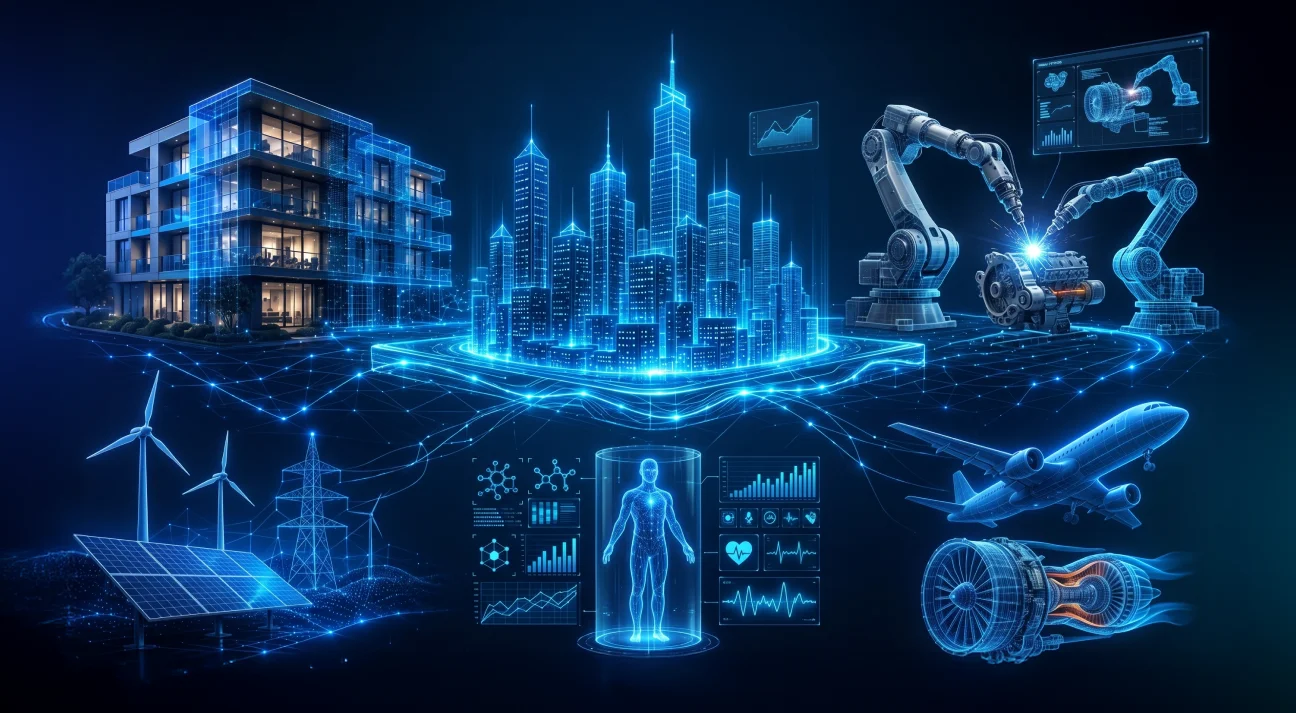
The way businesses design, monitor, and operate physical systems is changing fast. Digital twins are at the centre of the way how businesses design, monitor, and operate physical systems.
Amidst the shift, the company you choose to build yours will determine whether it delivers real results or stalls at the pilot stage.
In 2026, hundreds of vendors claim to offer digital twin solutions. But the best digital twin development companies are not just software providers. They are teams that combine deep engineering knowledge with advanced Ominiverse, Unity and Unreal Engine solutions to build virtual models that mirror real-world conditions.
This guide covers the 10 best digital twin companies to evaluate in 2026, what they do well, which industries they serve, and how to choose the right one for your business.
What are Digital Twin Development Companies and Why Do you Need Them?
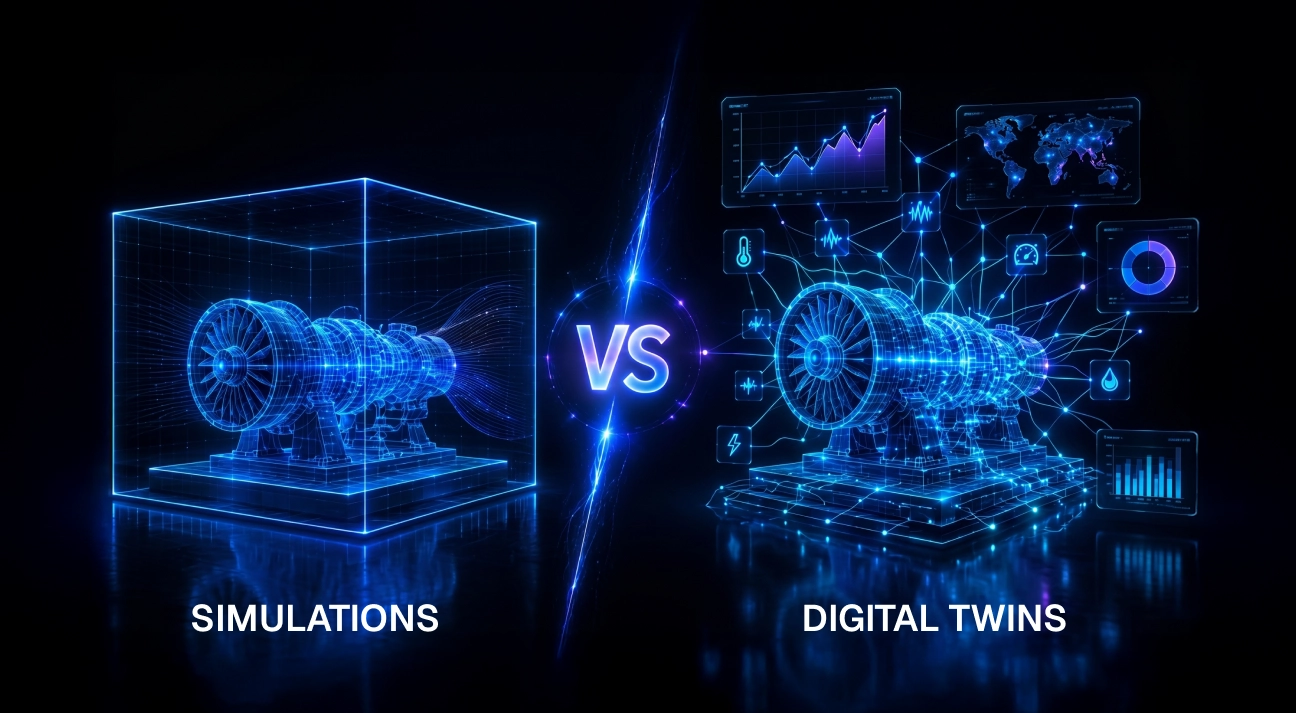
Digital twin technology providers are specialized organizations that help businesses design, build, integrate, and deploy virtual models of physical assets, systems, or processes. They help businesses turn raw operational data into actionable intelligence.
These companies could be:
- A platform vendor (like Siemens or Dassault Systèmes) that offers built-in tools and frameworks you configure for your needs
- A development studio (like 300Mind) that builds custom, industry-specific digital twin environments using game engines or simulation tools
- An IT services firm (like HCL Tech) that integrates digital twin capabilities into your existing enterprise architecture
You need a digital twin development company because building a production-grade virtual model requires more than software. It requires expertise in multiple specialized skills that most organizations do not have in-house:
- IoT data pipelines for connecting sensors and devices to feed your twin with accurate, real-time data.
- 3D modelling for creating precise virtual representations of physical assets and environments.
- Physics-based simulation replicates real-world behaviour, wear, and conditions inside the model.
- Real-time analytics for processing live data streams to surface actionable insights as conditions change
- Change management to help ensure your teams adopt, trust, and act on what the digital twin tells them
Top 10 Digital Twin Development Companies in 2026
Not all digital twin companies are built the same. Some specialize in platforms, some in custom development, and some in enterprise consulting.
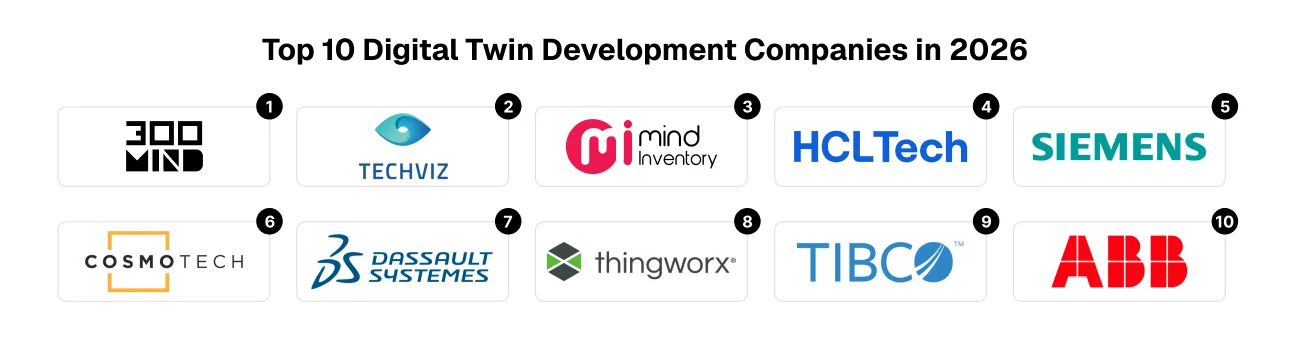
Here are the 10 best options to evaluate in 2026.
1. 300Mind
300Mind is an experienced digital twin development company which develops intelligent, real-time digital twins powered by Unreal Engine, Unity, and NVIDIA Omniverse.
They build behaviourally accurate, 3D replicas that allow enterprises to see, simulate, and command assets before making high-stakes decisions. What sets 300Mind apart is its use of AAA-grade 3D assets and immersive rendering alongside functional simulation. This makes their digital twins not just technically accurate but highly usable for decision-makers who are not engineers.
Their team are skilful in integrating IoT, AI, and enterprise data, connecting disparate systems like BIM, GIS, and ERP platforms into unified, continuous, and highly synchronized real-time pipelines.
300Mind aims at helping business take guesswork out with predictive, data-backed insights to optimize workflows, prevent unscheduled downtime, and safely train teams across manufacturing, healthcare, energy, and smart city infrastructure.
Key capabilities:
- Wind farm simulation using digital twin technology
- Synthetic dataset generation for AI training using 3D simulation
- Marketplace-ready assets and reusable real-time frameworks
- Industries served: Infrastructure, energy, industrial operations, smart cities
Why it matters: As enterprises demand digital twins that are both operational and visually accessible for executive decision-making, 300Mind’s approach bridges technical depth and visual clarity.
2. TechViz
TechViz is a French software company specializing in real-time 3D visualization for industrial applications. Its platform allows engineers and designers to review CAD and simulation data in virtual reality, turning large-scale digital twin data into human-navigable environments.
TechViz does not require teams to rebuild their CAD files from scratch. It reads native formats from major CAD and PLM tools directly, which significantly reduces integration friction.
Key capabilities:
- VR-based digital twin review environments
- Direct import from CATIA, NX, SOLIDWORKS, and other major CAD tools
- Scale visualization for large industrial assemblies
- Collaboration in shared VR spaces
Why it matters: With immersive collaboration becoming a standard expectation in engineering workflows, TechViz removes the gap between complex simulation data and human-scale decision-making.
3. MindInventory
MindInventory has positioned itself as a reliable digital transformation partner, delivering scalable digital twin solutions built around real business needs.
With expertise across industries such as manufacturing, healthcare, logistics, and smart infrastructure, they combine technical capabilities with domain knowledge to solve complex challenges.
MindInventory also focuses on aligning digital twin strategies with business goals, helping organizations achieve measurable results, operational efficiency, and long-term ROI.
Key capabilities:
- End-to-end expertise in digital twin solutions
- Advanced capabilities in IoT, AI/ML, and cloud technologies
- Tailored digital twin solutions built for predictive maintenance, operational efficiency, and asset performance tracking
- Enterprise-ready, scalable architectures developed to support high performance
Why it matters: As digital twins move beyond large enterprises, companies like MindInventory make the technology accessible to smaller organizations and mid-scale organizations without sacrificing customization.
4. HCL Tech
HCL Tech (HCLTech) is a global technology services firm with a dedicated digital twin practice that covers consulting, design, implementation, and ongoing maintenance.
Their approach combines advanced modelling, real-time operational data, and AI/ML to create virtual replicas of physical assets and processes.
HCLTech differentiates itself through deep industry experience across manufacturing, energy, and automotive sectors, combined with strong partnerships with platform vendors.
Their consulting-led entry model, where they first assess your current data landscape before recommending a digital twin architecture, helps clients avoid over-engineering their early implementations.
Key capabilities:
- End-to-end digital twin consulting and implementation
- AI/ML-based predictive maintenance and operational insights
- Integration with existing PLM, ERP, and SCADA systems
- OT-IT convergence and data pipeline engineering
Why it matters: For enterprises with complex legacy infrastructure, HCLTech’s experience in connecting operational technology (OT) with enterprise IT systems is significant advantage.
5. Siemens
Siemens through its Xcelerator business platform, delivers an integrated suite that connects product design, engineering simulation, manufacturing operations, and real-world performance data into a unified digital twin environment.
In January 2026, Siemens launched the Digital Twin Composer at CES 2026. It is a new tool designed to make the creation and orchestration of complex industrial digital twins significantly faster and more accessible.
Siemens has also expanded its partnership with NVIDIA on the industrial metaverse, combining Siemens’ simulation tools with NVIDIA’s AI platforms.
Key capabilities:
- Teamcenter: A product lifecycle management platform that connects engineering, manufacturing, and supply chain teams around a single source of product data.
- Simcenter: A simulation and testing suite that validates product performance across mechanical, thermal, and fluid dynamics scenarios before physical production begins.
- Insights Hub: (formerly MindSphere) — An industrial IoT analytics platform that collects, processes, and visualizes operational data from connected assets across factory environments.
- Digital Twin Composer: Launched at CES 2026, this tool simplifies and accelerates the creation of complex industrial digital twins for enterprise deployments.
Why it matters: Siemens is the benchmark for end-to-end industrial digital twins that span product design through operational performance. No other vendor matches the breadth of their lifecycle coverage.
6. Cosmotech
Cosmotech is a global technology company which specializes in digital twins that do not just monitor what is happening but simulate future scenarios and recommend the best course of action to meet specific business objectives. They call it Prescriptive Simulation Twins.
Their experience and offerings make them valuable particularly for supply chain managers, city planners, and energy operators who need to evaluate multiple decision pathways before committing to one.
Their platform allows users to virtually test action plans against complex variables such as demand fluctuations, resource constraints, climate events and compare the outcomes transparently.
Cosmotech is a member of the Digital Twin Consortium, underscoring its commitment to industry standards.
Key capabilities:
- Prescriptive Simulation Twins: It simulates multiple future scenarios and recommends the most effective action plans aligned with your specific business goals and KPIs.
- Supply Chain Resilience and Optimization Modelling: Models complex supply chain variables including demand shifts, supplier disruptions, and more to help decision-makers build more resilient and efficient operations.
- Energy and Infrastructure Simulation: Simulates energy grids, utility networks, and infrastructure systems under varying conditions, enabling operators to plan investments and manage resources with greater confidence.
- KPI-Aligned Action Plan Testing: Allows teams to virtually trial multiple strategies against set performance targets, comparing outcomes transparently before committing resources to any real-world action.
Why it matters: As supply chains remain volatile and energy transitions accelerate, Cosmotech’s prescriptive approach moves digital twins from monitoring tools to strategic decision engines.
7. Dassault Systèmes
Dassault Systèmes has been developing what it calls Virtual Twin Experiences since 2014 through its 3DEXPERIENCE platform.
In early 2025, the company launched 3D UNIV+RSES. It is a significant evolution that adds real-time data analytics, generative AI, and immersive XR experiences to its longstanding PLM platform.
In February 2026, Dassault Systèmes also announced a deepened partnership with NVIDIA, bringing accelerated computing and AI libraries together with their virtual twin platforms.
The 3DEXPERIENCE platform now serves more than 45 million users and 400,000 customers globally, making it one of the most widely adopted digital twin environments in the world.
Dassault also collaborates with Apple Vision Pro through its 3DLive app, which allows digital twins to be projected into physical spaces for immersive review.
Key capabilities:
- 3DEXPERIENCE Platform: A unified product and process lifecycle management environment that connects engineering, design, manufacturing, and operations teams around a single, continuously updated virtual twin.
- 3D UNIV+RSES: An evolution of the 3DEXPERIENCE platform that layers generative AI, real-time data analytics, and immersive XR experiences on top of existing product and process models.
- VecAssess: An AI-powered tool within the UNIV+RSES platform that analyzes existing virtual twin models and actively generates operational suggestions, maintenance recommendations, and design improvement opportunities.
- Apple Vision Pro Integration via 3DLive: Allows engineers and stakeholders to project digital twins from the 3DEXPERIENCE platform directly into their physical surroundings for immersive, hands-free spatial review and collaboration.
Why it matters: Dassault Systèmes’ evolution toward AI-generated scenarios and XR- enabled collaboration represents the most advanced version of virtual twin technology available at commercial scale today.
8. PTC ThingWorx
PTC’s ThingWorx is an industrial IoT platform that has built digital twin capabilities into its core architecture. It allows organizations to model physical machines and systems as digital representations that track real-time data and behaviour of the asset.
ThingWorx integrates with PTC’s broader portfolio including Creo (CAD), Windchill (PLM), and Vuforia (augmented reality) to provide a connected workflow from product design to factory floor operations.
Key capabilities:
- Real-Time IoT Connectivity and Digital Twin Modelling: Connects physical machines and systems to live digital representations that continuously track operational data, asset state, and behavioural patterns.
- ThingWorx 10.0 with Advanced IoT Streams and Security: The latest platform release delivers enhanced IoT data streaming, TLS 1.3 encryption, and Java 21 support for scalable and secure industrial deployments.
- Integration with Creo, Windchill, and Vuforia AR: They bridge product design, lifecycle management, and augmented reality into one connected workflow, linking engineering data directly to factory floor operations and field technicians.
- Predictive Maintenance and Quality Control Applications: It analyses real-time asset performance data to identify early warning signs of equipment failure, reducing unplanned downtime and improving overall production quality.
Why it matters: For manufacturers that need a digital twin platform tightly integrated with CAD, PLM, and AR tools, PTC ThingWorx provides one of the most cohesive ecosystems available.
9. TIBCO Software
TIBCO Software (now part of Cloud Software Group) has a data-and-analytics-first approach to digital twins. Rather than starting with 3D models, TIBCO builds digital twins rooted in-real-time data streams and event processing.
This makes them a strong fit for organizations where the primary intent is operational intelligence rather than product design.
TIBCO’s platform is particularly effective in asset-heavy industries where integrating data from disparate systems such as SCADA, historians, ERP, cloud, etc is the main challenge.
Their digital twin capabilities are placed within a broader integration and analytics architecture that many large enterprises already use.
Key capabilities:
- Real-Time Event Processing and Data Integration: Captures and processes live data streams from multiple sources simultaneously, ensuring your digital twin always reflects current operational conditions accurately.
- Digital Twin Modelling Grounded in Operational Data Streams: Builds virtual asset models directly from live operational data rather than 3D designs, prioritizing real-world accuracy over visual representation.
- Enterprise Integration with Legacy OT and IT Systems: Connects seamlessly with existing SCADA systems, data historians, and ERP platforms, eliminating data silos without requiring costly infrastructure replacements.
- Analytics Dashboards for Operational Decision Support: Translates complex operational data into clear, actionable dashboards that help teams monitor performance, identify issues, and make faster informed decisions.
- Why it matters: Organizations that already use TIBCO’s data infrastructure can extend their existing investment into digital twin territory without adopting an entirely new platform stack.
10. ABB
ABB has been developing concepts related to digital twins since the 1980s. Today, their digital twin strategy is built around the ABB Genix Digital Twin Hub and the ABB Ability System 800xA Simulator. These two tools create performance-based digital replicas of plant control systems and industrial processes.
ABB’s approach to digital twins is based on what they call perspective-based data modelling. Rather than organizing information in folders and files, data is structured around aspects of objects such as connecting engineering parameters, operational data, and maintenance history in a unified model.
In 2025, ABB integrated an AI-powered 3D visualization capability (via Cloudworx) into its digital twin offerings, further advancing its smart factory offerings.
Key capabilities:
- ABB Genix Digital Twin Hub: Monitors process performance in real time by creating digital replicas of industrial plant systems, assets, and operational workflows.
- System 800xA Simulator: Builds digital replicas of plant control systems, allowing operators to test configurations, train personnel, and validate changes without disrupting live operations.
- AI-Powered 3D Visualization via Cloudworx: Integrates AI-driven 3D visualization into digital twin environments, helping OEMs simplify equipment selection, commissioning, and troubleshooting across industrial settings.
- ASKI and InSite Energy Monitoring: Tracks and analyzes energy consumption across industrial facilities, providing precise data that supports cost reduction and sustainability targets.
Why it matters: For process-intensive industries with complex control systems, ABB offers digital twin capabilities that are deeply embedded in automation infrastructure and not bolted on top of it.
How to Choose the Right Digital Twin Development Company?
Before evaluating any company, identify your primary goal. The table below maps each goal to what you should prioritize, what to validate, and a real-world example to guide your thinking.
| Primary Goal | What to Prioritize | What to Validate | Example |
| Operational Optimization | Real-time asset monitoring, reliability outcomes, and tight integration into existing operational workflows | Does the platform drive interventions, or does it only generate reports? | A cement plant uses ABB Genix Digital Twin Hub to monitor kiln performance in real time and reduce unplanned shutdowns |
| Simulation and Scenario Planning | Model fidelity, explainability, and the ability to test multiple futures against defined KPIs | How does scenario performance hold under complexity? What skills are needed for long-term model maintenance? | A logistics company uses Cosmotech Prescriptive Simulation Twins to test supply chain strategies before committing to inventory decisions |
| Enterprise-Wide Visibility | Integration breadth across SCADA, ERP, PLM, and cloud systems, and scalability across multiple sites | Does the platform reason across system dependencies, or only show individual asset dashboards? | A global manufacturer deploys Siemens Xcelerator to connect product design, factory operations, and performance data across 12 facilities |
| Immersive Visualization and Communication | 3D rendering quality, real-time interactivity, and accessibility for non-technical stakeholders | Can the digital twin be navigated and understood by decision-makers who are not engineers? | An infrastructure developer uses 300Mind to build a city-scale digital twin that executives and city planners can explore interactively |
| Product Design and Lifecycle Management | CAD and PLM integration, simulation accuracy across physics domains, and version control across design iterations | Does the platform support the full journey from design to manufacturing to in-service performance? | An aerospace company uses Dassault Systèmes 3DEXPERIENCE to simulate structural behaviour and validate designs before physical prototypes are built |
Every business goal demands a different capability:
- Operational teams need real-time intervention, not dashboards.
- Planners need scenario fidelity, not feature lists.
- Enterprise leaders need system-wide integration, not isolated asset views.
- Designers need lifecycle depth.
- Communicators need clarity over complexity.
The mistake most organizations make when comparing digital twin technology providers is evaluating platforms in isolation and scoring their features against a checklist rather than testing outcomes against a real problem.
Match the platform to the outcome, not the other way around. Pick the one that solves your problem, not the one that looks good on paper.
Conclusion
Choosing from the top digital twin platforms in 2026 comes down to one question i.e., what operational problem are you solving?
The 10 companies in this guide cover the full spectrum right from enterprise lifecycle management to immersive 3D visualization to prescriptive scenario planning. There is no single best vendor. There is only the right fit for your industry, your data maturity, and your business goals.
Start with a clearly defined use case, run a proof of concept, and measure outcomes before scaling. The companies that will lead in this space are the ones that treat digital twins as a decision-making capability and not just a technology investment.
FAQs
Digital twin companies improve project efficiency through real-time monitoring, predictive insights, and data analytics. By identifying issues early, businesses can reduce downtime, improve resource utilization, streamline operations, and make faster, data-driven decisions that enhance overall project performance.
Top digital twin companies should offer real-time data integration, predictive maintenance, IoT and AI compatibility, scalability, and industry expertise. These capabilities help businesses improve operational visibility, optimize performance, simulate outcomes, and support better long-term decision-making.
All three are real-time 3D platforms but serve different strengths. Unreal Engine 5 is preferred for high-fidelity visual environments and large-scale simulations.
NVIDIA Omniverse is built for collaborative, physics-accurate industrial digital twins with strong AI integration.
Unity is widely used for interactive applications, training simulations, and mid-market digital twin projects where flexibility and cost efficiency matter.
Digital twins are virtual replicas of physical systems, assets, processes, or environments that use real-time data to mirror real-world performance. Businesses use digital twins to monitor operations, predict issues, test scenarios, optimize performance, and improve decision-making without disrupting actual systems, making operations smarter, faster, and more efficient.