What Is the Difference Between a Simulation and a Digital Twin? A Complete Guide

Engineers, operations managers, and technology decision-makers often use the terms simulation and digital twin interchangeably. They are not the same thing.
Both technologies use virtual models. Both help organisations make better decisions. But they work differently, serve different purposes, and deliver value at different stages of the asset lifecycle.
Understanding the difference between digital twin’s vs simulations is not a matter of technical curiosity. It is a practical business decision that affects where you invest, what infrastructure you build, and what questions you can answer.
This guide explains both clearly, so you can choose the right tool for the right job.
What is Simulation?
Simulation refers to the creation of a digital model that imitates a real-world process, system, or situation within a controlled virtual environment. It uses mathematical formulas, computer models, and data-driven logic to replicate how systems behave under different conditions without directly interacting with the real environment.
Simulations are widely used to analyze:
- system performance
- test new ideas
- identify risks
- forecast outcomes under specific conditions and constraints
Unlike basic data analysis, simulations create interactive virtual environments where variables can be adjusted to observe how changes affect overall system behaviour.
Engineers, technicians, researchers, and businesses use simulations across various industries to test products, processes, workflows, and operational concepts before real-world implementation. This helps reduce cost, improve efficiency, minimize risk, and support better decision-making.
For example:
- Manufacturing companies simulate production lines to identify bottlenecks.
- Healthcare organizations simulate medical procedures and patient flow.
- IT teams simulate network performance and cybersecurity scenarios.
- Automotive and aerospace industries test vehicle and aircraft designs through simulation models.
By enabling safe experimentation and predictive analysis, simulations help organizations make informed decisions while saving time and resources.
What is Digital Twin?
A digital twin is a virtual model that is created to reflect an existing physical object. The physical object is fitted with sensors that produce data about different aspects of the object’s performance, for example on a wind turbine.
This data is then relayed to a processing system and applied to the digital model. This digital model, or twin, can then be used to:
- run simulations
- real-time data monitoring
- study current performance
- identify potential improvements that can be applied to the actual physical asset
A digital twin can also be created for non-physical processes and systems, mirroring the actual process or system and allowing simulations to be run based on real-time data.
The digital twin models are in high demand. As per Markets and Markets, the global digital twin market is expected to grow to $149.81 billion in 2030 from $21.14 in 2025 at a CAGR of 47.9%.
You can build a digital twin model using Unreal Engine 5. These advanced twin models can be used by:
- Automotive manufacturers use it to simulate and optimize vehicle design, test components virtually, and reduce physical prototyping costs before production.
- Aerospace and defence firms leverage digital twins to validate every step of the product design process digitally.
- Energy & utilities companies can use it to monitor power grids, wind farms, and infrastructure in real time.
- Consumer products brands use it to streamline manufacturing parameters and improve production efficiency.
- Life sciences & healthcare organizations can utilize digital twins to plan surgical procedures, optimize drug dosages, and test medical devices safely.
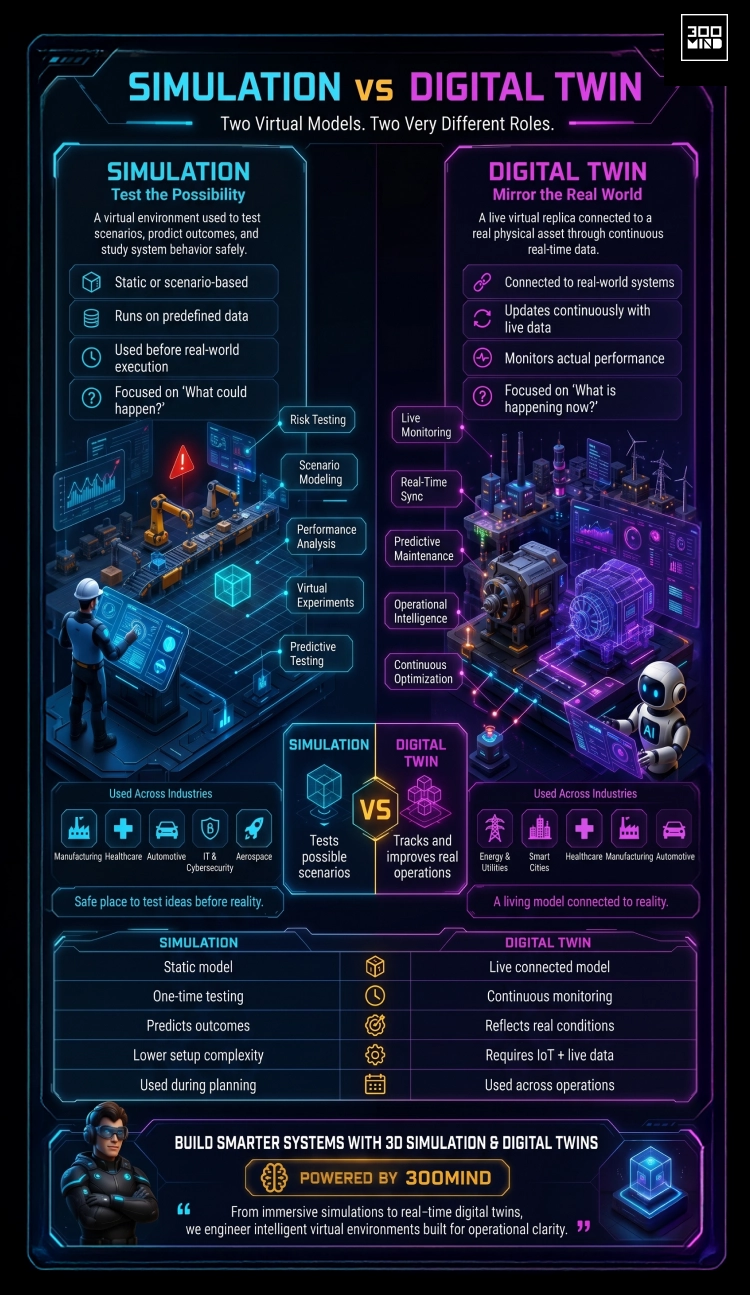
Key Differences: Simulation vs. Digital Twin
Both technologies use virtual models and process data. At a surface level, they look similar. But their underlying architecture, data relationships, and operational value are fundamentally different.
“A simulation tells you what might happen. A digital twin tells you what is happening and then helps you improve it.”
1. Static vs. Active
A simulation is a closed system. Engineers define the boundary conditions, input parameters, and governing equations. The model then runs within those constraints. It can’t communicate and react with the real world because it has no connection to it.
On the other hand, a digital twin is an open, continuously synchronized system. It fetches data such as temperature, pressure, vibration, throughput through live telemetry from IoT sensors.
It then updates the virtual model in real time. The twin does not wait for an engineer to decide what to test next. It reflects what is happening, at whatever fidelity and frequency your sensors allow.
2. Possible vs. Actual
Simulations operate in possibility space. A digital twin operates in actuality.
Simulations require you to define a scenario, set the variables, and the model shows you what would happen if those assumptions were correct. The output is only as accurate as the inputs you chose.
Consider an engineer simulating how a bridge behaves under heavy traffic load. They define the load weight, distribution, material properties, and weather conditions. The simulation produces results based on those choices. But if real traffic patterns differ from what was assumed, or if a material has an undetected quality issue, the simulation will not catch it. It can only work with what it was told.
On the other hand, a digital twin starts with reality. The sensors on the physical asset continuously feed live measurements into the twin. The twin does not assume. It observes continuously.
Continuing the same bridge example, a digital twin would detect an unexpected stress concentration in a specific span during peak traffic hours, not because an engineer modelled that scenario, but because strain gauges measured it.
The simulation tells you what might happen under conditions you anticipated. The twin tells you what is happening under conditions that exist.
3. Scope of Use
Simulations deliver helps in the pre-production stage for activities such as stress testing, design iteration, failure mode analysis, regulatory validation. Once the asset is deployed, their usefulness becomes intermittent. The engineers only return to simulation for specific investigations or redesign efforts.
However, digital twin has a continuous utility. It generates value across the entire asset lifecycle, i.e. design, commissioning, in-service optimisation, maintenance, and eventual decommissioning.
Each stage adds data that makes the digital twin more accurate and more useful over time.
The simulation has an end date. The twin does not.
For instance, during design stage, engineers simulate blade geometry and fatigue stress. On the bases of this simulation the turbine is built. The simulation’s role ends, to a large extent.
However, the digital twin still continuous to operate. Sensors track live vibration, temperature, and rotor performance throughout the turbine’s operating life. Three years in, the twin flags abnormal blade stress that no simulation anticipated. Maintenance is scheduled much before time, and a costly failure is avoided.
4. Data Architecture
Simulations consume batch datasets such as historical records, design specifications, lab measurements and more collected before the model runs. The data pipeline in case of simulation is one-directional and episodic.
Digital twins require a persistent, bi-directional data infrastructure. This includes edge devices and IoT sensors at the physical layer, real-time ingestion pipelines, time-series databases for status tracking, and processing systems that can handle continuous streaming data with low latency.
Beyond the core data pipeline, integration with SCADA, MES, and ERP systems is typically required to give the twin full operational context. Asset health data alone is not enough. The twin needs to know production schedules, maintenance records, supply chain constraints, and energy costs to generate decisions that are operationally meaningful.
5. Cost and ROI
Simulations have a limited and predictable cost. Companies mainly spend on software, computing power, and engineering time. The return usually comes at specific moments, like catching a design flaw early, avoiding an unnecessary prototype, or speeding up regulatory approvals.
Once the project is complete, the simulation work often ends.
Digital twins work differently. They require a much larger upfront investment, including sensors, network infrastructure, data platforms, and system integration. However, the value they create continues over time.
A well-designed digital twin keeps generating benefits every day through reduced downtime, longer equipment life, better maintenance planning, and lower energy consumption.
For instance, Rolls-Royce builds a virtual copy of each physical engine and connects it to on-board sensors and satellite systems that continuously relay live operational data back to the twin. Engineers use this data to move away from fixed maintenance schedules toward condition-based servicing: each engine is maintained according to how it has been used, not what a manual assumes.
The result is fewer unnecessary maintenance visits, longer service intervals, and fewer in-service failures.
| Dimension | Simulation | Digital Twin |
| Data type | Static or point-in-time data | Live, continuous, two-way data |
| Connection to reality | Tests hypothetical scenarios | Reflects real-world conditions |
| Lifecycle scope | Used mainly during design and testing | Used across the full product lifecycle |
| Update frequency | Updated manually for each run | Continuously updated in real time |
| Core question answered | “What could happen?” | “What is happening and why?” |
| IoT dependency | Not required | Essential for real-time data |
| Typical cost | Lower upfront cost | Higher investment in sensors and infrastructure |
| ROI model | Savings from avoiding errors or redesigns | Continuous operational and maintenance gains |
| Best for | Design, planning, training, testing | Monitoring, predictive maintenance, optimization |
When to Use Each Technology?
Choosing between a simulation and a digital twin is not about which technology is better. It is about which one fits your current stage in the asset lifecycle and what question you need to answer.
Use a Simulation When:
- You are in the design or pre-production phase, and the asset does not yet exist.
- You need to test how a system behaves under different conditions before committing to a physical build.
- You want to run multiple scenarios quickly, changing variables and comparing outcomes without real-world risk.
- You do not need live sensor data or IoT infrastructure to get the answers you are looking for.
- Your budget does not support the setup costs a digital twin requires.
- The core question you are trying to answer is: “What would happen if we changed X parameter?”
Best suited for: Product engineering, financial modelling, urban planning, aerospace design, military training, and pharmaceutical trials.
Use a Digital Twin When:
- You have a physical asset already in operation and need to know how it is performing right now.
- You need real-time visibility into equipment condition, output quality, or system behaviour.
- Unplanned downtime, equipment failure, or operational inefficiency carries significant financial or safety consequences.
- You want to move from reactive maintenance, where you fix things after they break, to predictive maintenance, where you act before they do.
- The core question you are trying to answer is: “What is happening right now, and how can we improve it?”
Best suited for: Manufacturing, energy infrastructure such as wind turbines and power grids, smart cities, healthcare equipment, logistics and supply chain operations, and oil and gas.
How Simulations and Digital Twins Work Together?
Simulations and digital twins are not competing technologies. They serve different stages of the same lifecycle and work best when used in sequence.
Simulations come first. During the design phase, they help engineers test assumptions, eliminate weak designs, and identify which variables matter most. They also inform where sensors should be placed once the physical asset is built, laying the groundwork for the digital twin that follows.
Once the asset is in operational state, the digital twin takes over. It monitors real-world performance, tracks condition, and feeds predictive maintenance models. But its value does not stop at operations.
The data a digital twin collects flows back into future simulations. Real operating conditions, actual failure patterns, and observed performance gaps replace the assumptions the original simulation was built on. Each cycle makes the next simulation more accurate.
Organisations can also run simulations directly inside a live digital twin. This allows engineers to test proposed changes against real operational data before implementing anything in the physical world.
The result is a continuous loop:
| Simulation to Designing a Digital Twin Model ↓ From Deploying a Digital Twin to Operating It ↓ Use What the Twin Learns to Simulate Better |
For instance, a manufacturer building a new industrial pump, runs simulation before production to test pressure tolerances, flow rates, and material stress under different operating conditions. The simulation informs the final design and identifies the most critical components to monitor.
Once the pump is installed and running, a digital twin takes over. Sensors track live pressure, temperature, and vibration data in real time. Six months into operation, the twin detects that a specific valve is degrading faster than the simulation predicted, because real fluid chemistry at the customer’s site is more corrosive than the lab conditions the simulation assumed.
That finding feeds back into the next simulation cycle. The design team updates their material assumptions, tests alternative valve compositions virtually, and ships an improved version. The simulation made the first pump possible. The twin made the next one better.
How Can 300 Mind Help?
300Mind helps businesses turn complex operations into intelligent, interactive digital environments through advanced simulations and digital twins. By combining technologies like Unreal Engine Solutions, NVIDIA Omniverse, Unity Engine Solutions, AI, and IoT integration, the company builds real-time models that mirror physical systems with high accuracy.
These digital twins help organizations monitor performance, predict failures, test scenarios, optimize processes, and improve operational visibility without disrupting real-world operations. From manufacturing and energy to healthcare, automotive, and smart cities, 300Mind develops scalable solutions designed for better decision-making and long-term operational efficiency.
Whether you need a simulation platform, predictive maintenance system, or a city-scale digital twin, 300Mind can help you build it.
FAQ on Digital Twin vs Simulation
A digital twin is not the same as a simulation, although simulations are often part of a digital twin system. A simulation is usually built to test a specific scenario or predict what could happen under certain conditions.
A digital twin, on the other hand, is a live virtual model connected to real-world data through sensors and systems. It continuously updates to show the current state of a physical asset, process, or environment, helping businesses monitor performance, predict issues
Digital twins and simulations are similar in some ways because both use virtual models to represent real-world systems, processes, or products. They help organizations analyze behaviour, test scenarios, improve performance, and reduce risk without affecting physical operations. Both are used to support decision-making, lower development costs, and speed up innovation. In many cases, simulations are integrated into digital twins to test different conditions and predict future outcomes more accurately.
A digital twin can run simulations against live operational data. Instead of relying on assumed inputs, engineers can test proposed changes, maintenance needs, or design modifications against the actual, real-time state of the asset.
Not necessarily, but the two serve different purposes. If your work is primarily in the design or pre-production phase, simulations may be sufficient. However, once an asset is operational, simulations alone cannot tell you what is happening in real time. To enhance the operations of the asset you need to exploit digital twins which provide you predictions in advance.